The Governess's Manuscript
The Turn of the ScrewThe Governess's Manuscript is the handwritten account through which the events at Bly reach the reader. It is at once a physical object passed from a dead woman to Douglas and a recollection that he preserves, then entrusts to a later narrator. That layered transmission gives the account an intimate origin and a carefully staged public audience, while making the governess’s testimony the indispensable medium through which the story is known.
Provenance and Physical Form
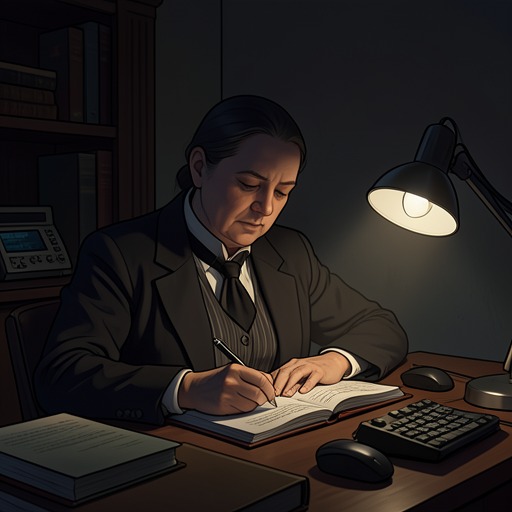
Douglas says that the manuscript is written in old, faded ink and a beautiful hand. Its author, a woman who has been dead for twenty years, sent him the pages before she died. He identifies her as his sister’s governess, recalls her as charming and unusually agreeable in her position, and says she was ten years older than he was. Their acquaintance began when he was at Trinity: after returning home for the second summer, he spent much of that year with her, talking and walking in the garden during her off-hours. He liked her, believed that she liked him, and insists that she had never told anyone else what she eventually told him. The manuscript therefore begins not as a document commissioned for an audience, but as a private confidence entrusted to someone with whom its author had formed a close attachment.
The pages are not a contemporaneous record kept during the events they describe. Asked whether the account was his own record, Douglas answers that he has only the impression, which he says he took into his heart and never lost. The distinction separates the manuscript from Douglas’s memory: he did not write down the original events as they happened, but received the governess’s written statement afterward. His confidence in his recollection helps establish the account’s chain of custody, yet it also makes clear that the narrative arrives through more than one act of remembering and telling.
Preservation and Public Reading
Douglas does not immediately produce the pages when asked about them. After he says that the narrative requires a prologue for proper understanding, the outer narrator explains that the text he is about to provide is an exact transcript made much later. Before his own death, when it was in sight, Douglas committed the manuscript to that narrator. It had reached Douglas on the third of the gathering’s four days, and on the fourth night he began reading it aloud by the same hearth where the company had previously discussed the story.
The reading turns a private document into a shared experience. The women who had said they would stay leave after the earlier hints have intensified their curiosity; their departure leaves a smaller, more select audience gathered around the fire, united by a common thrill. Douglas reads with such clarity that the outer narrator remembers the performance as rendering the beauty of the author’s handwriting to the ear. The manuscript’s material elegance is thus translated into an oral event: the absent governess’s hand is heard through Douglas’s voice, then carried forward by another person’s transcript.
That transcript is itself presented as the result of a later act of preservation. The outer narrator does not claim to have witnessed the events at Bly, but to reproduce the manuscript from a copy made afterward. The account’s transmission therefore has distinct stages: the governess writes, sends the pages to Douglas, Douglas keeps them and reads them to the gathering, and the outer narrator later transcribes them. Each stage brings the narrative closer to a new audience while preserving the distance between that audience and the original experiences.
Narrative Position and Limits
The manuscript begins after the governess’s story has already, in a manner, begun. Douglas’s prologue supplies the circumstances of her appointment before the written account opens: she is the youngest of several daughters of a poor country parson, twenty years old, and taking service in a schoolroom for the first time. She has come to London in trepidation to answer an advertisement with which she has already corresponded. At a large house in Harley Street she meets the prospective employer, a handsome, wealthy bachelor whose manner and request strike her with particular force. He asks her to proceed to his country home in Essex. The opening thus places the manuscript within a life and a decision that its first pages do not narrate from the beginning.
The gap between the events and their written account matters. The governess’s pages are not introduced as a daily journal written in the immediate present; Douglas instead describes a statement sent to him before its author’s death, while the outer narrator supplies a transcript made much later. The reader encounters the story through a document whose author is absent, whose original wording is mediated by performance and transcription, and whose recipient remembers its effect as well as its contents. The account’s authority rests partly on its intimate provenance, but its form also makes the reader attend to what can and cannot be verified from a remembered, handwritten testimony.
Significance of the Manuscript
The manuscript binds the story’s private and communal frames together. Its origin lies in a confidence shared between the governess and Douglas, and its later reading gives that confidence the shape of a tale passed around a fire. The listeners’ questions about the account and the woman who wrote it are answered through Douglas’s recollection; only then does the text itself begin. The shift from conversation to reading changes the source of information without removing the framing voices that have prepared and received it.
Its most striking tension is between the solidity of the pages and the distance surrounding their contents. Douglas can point to faded ink, a beautiful hand, and a history of delivery; he can also testify to the author’s character and to the impression she made on him. But the manuscript reaches the reader through his act of reading and another narrator’s later transcript. Its physical survival gives the narrative a traceable history, while its layered transmission keeps the reader aware that the governess’s account is encountered through acts of preservation, memory, and interpretation.